
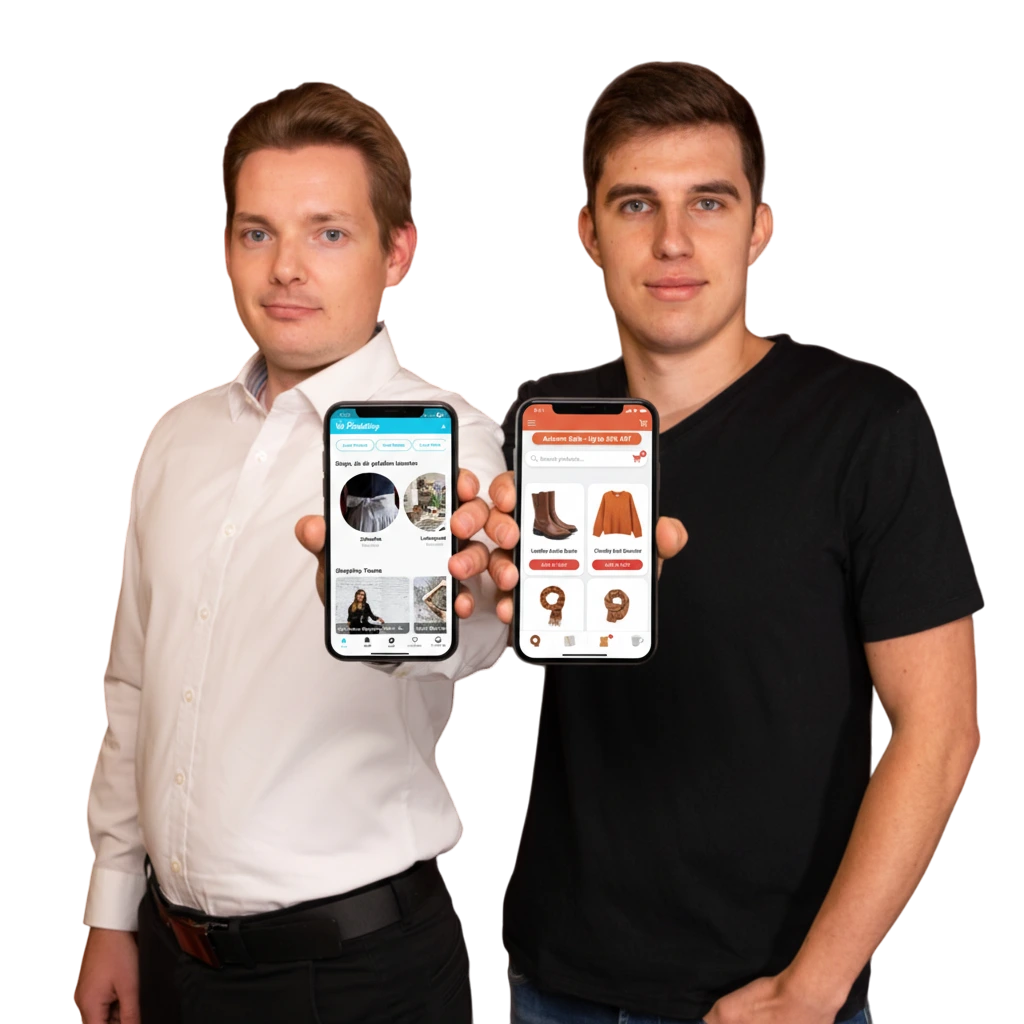
100+ projects in web, app and platforms
Direct contact, technical classification and a concrete suggestion for the next sensible step.
We guide your app project from idea to launch. Get a clear estimate of costs and timeline, plus guidance on the right platform for iOS, Android, or web.
Answer a few questions to get a rough cost estimate and initial guidance on next steps.
We build custom apps with transparent costs, reliable technology, and development by our in-house team in Germany. Looking to create an app or hire a team to develop, program, or build one? In recent years, we have over 100 projects worked with startups, mid-sized companies, and enterprises to deliver:











A production-ready MVP is more than a clickable prototype: it’s a usable first version with a backend, authentication, and well-structured data storage. CodeGuides focuses on the core features that demonstrate the product’s value, building them on a foundation that can grow without starting over. A successful first step begins with a clearly defined scope, not an endless feature list.
Depending on the scope, a focused MVP may be possible in about three months, provided the core features are clearly defined. Integrations with existing systems, complex user roles, data migrations, or external approvals can extend the timeline. A production-ready MVP is more than a clickable prototype, so we focus on the features that deliver the most value.
As a rough guide, a prototype costs around €8,000 to €20,000; a production-ready B2B MVP with a backend costs €25,000 to €60,000; and a complex business app or platform costs €60,000 to €150,000 or more. The exact estimate depends on scope, platforms, and integrations. Get a no-obligation estimate App cost calculator or read the cost guide.
This guide covers the factors that matter when making an informed decision: budget, timeline, platform selection, and how to choose the right development partner. Whether you're building a new app or modernizing an existing one, the focus is on clear, practical guidance—not hype.
Suitable performance: App development agency for companies. More guides: App development costs, App maintenance costs, App development timeline, Choosing an app development agency, Initial consultation checklist, App development cost calculator, App agency selection criteria, Build an app, App development, Find an app development agency, Custom app development, Who can develop an app for me?, Who programs apps?, App developer vs. app development agency.
The factual answer: App development costs depend less on the app itself than on platforms, backend, integrations, offline use, role model and quality standards. Here you will find realistic framework values from B2B projects.
Core use case, login, basic UI, simple data, basic backend or connection.
Multiple roles, rights, offline, push, more complex UI, multiple integrations.
Real-time, payment, chat, AI, many integrations, admin, analytics, scaling.
An MVP can often be built in 8–12 weeks if the goal, core use case, and key decisions are clear. More complex apps take several months because integrations, user roles, and quality assurance take time. An MVP can help you win over potential customers, generate initial revenue, and learn more about your long-term product. That's why we scope the first version to be useful early while providing a stable foundation for future development.
For a successful app project, the process, responsibilities, and technical implementation need to work together. That helps keep the budget, timeline, and outcome on track.
Preparing these details can make your project faster, more affordable, and easier to plan. If you haven't, that's fine—we can work through them in a workshop, though it may take more time.
This decision has a major impact on cost and time to market. We offer practical advice: target audience, feature set, and team structure matter more than technical dogma.
One codebase, faster iteration, and strong value for money.
Maximum integration with the platform and support for specialized hardware, with plenty of room for optimization.
Easy to access, with no app store release required—well suited to internal processes.
Many providers offer app development but deliver only the code. You need a team that understands product development, architecture, and operations. This checklist can help you avoid common problems.
For many companies, the priority is a mobile app that runs reliably on iOS and Android. We build native or cross-platform apps, depending on what makes sense for your audience, use case, time to market, and budget.
A good fit if your users rely heavily on Apple devices or you need a premium user experience, strong performance, and a consistent device environment.
A good fit when device diversity, hardware integrations, or a broad user base matter—especially in B2B.
Often the practical choice: one codebase, a faster launch, and strong value for money—without compromising on quality.
B2B apps rarely fail because of the UI; process challenges are more often to blame, including roles, permissions, data quality, integrations, offline use, and change management. That's where we focus.
Admins, employees, partners, and customers often need different, finely tuned permissions and audit trails.
ERP, CRM, identity, ticketing, and third-party systems—and the reality is that data is never as clean as you'd hope.
Less of a nice-to-have and more of a must-have when processes depend on it. Monitoring and error handling are essential.
Pilot testing, feedback, iterative improvements, training, and change management—all supported by clear communication across the organization.
An MVP isn't a temporary fix; it's the first version of a system designed to grow. We build MVPs so you don't have to start over after a short time.
Focus on a core use case that delivers real value. Everything else can come later; trying to do too much makes the project harder.
Keep it as simple as possible and as stable as necessary—not overengineered, but without creating a mountain of technical debt.
An MVP can be small, but it shouldn't be unstable. Include crash reporting, testing, and analytics from day one.
The real work begins after the MVP: iteration, expansion, and scaling without having to rebuild everything.

As a Software development agency we develop your App and web app from the MVP development through to scalable operations. Whether you need a new platform Build app or modernize an existing solution, we provide architecture, development, and cloud setup from one team.
Workshops covering your business model, target audiences, usage context (mobile, tablet, or web), and feature set. We turn your vision into an app concept.
User journeys, wireframes, a design system, and technical architecture for iOS, Android, and web, including backend and API design.
Interactive prototypes and an initial app version to test core features and gather early user feedback.
Agile development in short sprints, covering the app frontend, backend, integrations, and quality assurance.
A reliable launch, including app store listings, analytics, crash reporting, monitoring, and performance optimization.
Regular updates, maintenance, security patches, and app improvements aligned with your roadmap.
Project calculator
Answer a few focused questions to get a realistic initial estimate during a consultation.




Custom, high-performance, and user-centered: we build apps that support your business model.
Planning a parallel platform? For web platform development. Do you need additional capacity in the short term? Book a development teamInterested in cross-platform development? Flutter Agency.
Services for custom app development: From MVP App development about Business app for iOS and Android up to hybrid app with common code base incl. Architecture, integrations and cloud scaling.
Workshops, user journeys, wireframes, and app design, from the initial idea to a clickable prototype.
Native and cross-platform apps with Flutter, React Native or .NET MAUI plus stable backends.
Scalable backends, APIs, and integrations with Docker and Kubernetes. Infrastructure as code and automated deployments.
Automated tests, code reviews, security scans and GDPR-compliant development.
Integrations with your existing systems (ERP, CRM, identity, payment, and third-party systems) for seamless workflows.
Scalable architecture, performance optimization, load testing, feature expansion, and monitoring.




We combine sound architecture with pragmatic implementation and stay by your side for the long term. We guide app projects from the initial idea and sketches through launch, ongoing operations, and scaling.

From simple apps to complex platforms with real-time chats, payment systems and AI integrations.
Quickly get to the first usable version without obstructing the long-term architecture.
No nearshore or offshore development: communication and quality stay within our team.
Most customers continue to expand their apps with us after the initial project.
We start with an initial consultation and a structured workshop. We clarify the target audience, core benefits, use cases, roles, and technical constraints. We then define a prioritized scope, a realistic schedule, and a sound budget framework. This gives you a clear basis for making decisions early on, rather than leaving you to rely on vague assumptions.
An MVP can often be delivered in about 8 to 12 weeks if goals and scope are clearly prioritized. Larger apps with complex backends, multiple roles, and integrations take longer. The key is to define the scope clearly so decisions don't have to be renegotiated throughout implementation.
Costs depend on scope, integrations, platforms, and quality requirements. Typical MVPs start at around €8,000, while business apps often cost significantly more. Before the project starts, we'll provide a reliable estimate based on transparent assumptions, either for clearly defined modules or for time and materials with a budget cap. For a detailed breakdown, see our guide: App development costs.
After launch, ongoing costs include hosting, updates, monitoring, security, and minor product improvements. Depending on the complexity, these often range from a few hundred to several thousand euros per month. For a detailed overview, see: App maintenance costs.
The process starts by clarifying goals and defining the scope, followed by UX, architecture, and a clear MVP plan. We implement the app in short sprints, with regular demos and coordinated releases. This lets you see progress early, make informed decisions, and keep your budget and timeline under control.
Look for verifiable references, clear responsibilities, transparent processes, and clear terms for code ownership. A good agency identifies risks early, provides reliable estimates, and considers ongoing operations and future development. For more details, see: App agency.
If you're just getting started, partners with experience in discovery and delivery are usually the most effective. They help you clearly define your vision, MVP, and budget before costly implementation begins. For a detailed breakdown, see our guide: Who can develop an app for me?.
Freelancers are a good fit for specific tasks without ongoing operational responsibility. But for a business app with a backend, integrations, user roles, reliable operations, and predictable releases, relying on a single freelancer can be risky: they may get sick, leave, or be overbooked, leaving your project without a backup plan. CodeGuides is an experienced in-house team based in Germany that takes full end-to-end responsibility. If you want a professional approach: Who programs apps?.
We develop for iOS and Android, either natively or cross-platform with Flutter, React Native, or .NET MAUI, depending on your goals. We also build web apps when needed. Together, we'll determine the right platform combination based on your target audience, use case, budget, and desired time to market.
Yes. We take over existing codebases, starting with a technical audit. We then stabilize critical areas, improve build and release processes, and gradually modernize the architecture and security. This creates a solid foundation for developing new features without constant rework.
Yes, we support you throughout the launch on the App Store and Google Play. This includes listing content, guideline checks, technical preparation, review support, and analytics and crash reporting setup. The goal is a controlled launch that covers not only publication but also follow-up improvements once the app is in operation.
You own the code and get access to the repository, build pipeline, and relevant operational systems. We document the technical structure and handover steps so your team can take over if needed. This keeps your product independent and gives you clear options for operations, maintenance, and future development.
If results matter, choose an agency that delivers, not just presents. CodeGuides develops apps with Flutter for iOS, Android, and web, entirely in-house in Germany, with no outsourcing or sugarcoating. We've completed more than 100 projects now in regular use. You'll have direct points of contact, a transparent assessment, and clear responsibility for development and operations. In a free initial consultation, we'll also tell you if your project needs adjustments.
Poor agencies promise everything, outsource work without telling you, and disappear after launch. Good agencies speak plainly, have an in-house team you can contact directly, take responsibility for operations, and stay involved for the long term. CodeGuides is in the latter category: 100% in-house in Germany, more than 100 completed projects, and the founders as direct points of contact. We'll also tell you when something won't work.
If data protection is a requirement, not just a buzzword, CodeGuides develops exclusively in Germany and preferably hosts on servers in Frankfurt and Nuremberg. We take GDPR requirements into account from the initial system architecture, including data minimization, TLS, data processing agreements, and clear consent processes—not as afterthoughts.
Mid-sized companies don't need an agency that builds its reputation on startup pitches or charges enterprise-level rates. They need predictable budgets, direct points of contact, and long-term accountability. CodeGuides offers exactly that. Our reference customers include Knorr-Bremse AG, SENSYS GmbH, Secanda AG, and Wildau University of Applied Sciences. Talk to us.
Startups need speed, efficiency, and an honest assessment of budget and scope—not an agency that quotes an ideal price and adds costs later. CodeGuides uses Flutter to build MVP apps for iOS and Android from a single codebase, helping you get to market faster with lower upfront costs and a scalable foundation. In an initial consultation, we'll clarify what's realistic.
If you're wondering whether an app is worth the investment, the answer depends on your business and the problem you want to solve. Digital processes that still rely on paper or email can cost time and money every month, while digitized competitors may be better positioned to win customers. CodeGuides has completed more than 100 projects in this area. In a free initial consultation, we'll help you identify where an app could make the biggest difference.
On paper yes, in practice almost always no. No-code tools quickly reach their limits when it comes to real business logic, interfaces and scaling. What starts cheaply often ends in an expensive migration to a professional solution. If you want to develop scalably and professionally from the start, you will save considerable time and money in the long term. CodeGuides develops business apps that are built for growth from day one.
The cost of custom interface development (APIs and integrations) depends on the complexity, volume of data, authentication requirements, and available documentation for the target system. Simple REST API integrations cost €2,000 to €8,000. Complex integrations with SAP, ERP, or legacy systems cost €10,000 to €40,000. During the initial consultation, we estimate the effort after reviewing the available system documentation.
Many app ideas fail not because of the idea itself, but because of how they are implemented. This is exactly where we start.

All consultations take place on Google Meet.
Your confirmation and calendar invitation will arrive by email right away.
The appointment can be rescheduled if needed.
I look forward to our consultation

CodeGuides develops apps for consumers and businesses, with a primary focus on B2C apps. Our in-house team in Germany provides product planning, Flutter development and long-term operations, alongside custom software, AI automation and local AI infrastructure.
Define the first release by user journeys and acceptance criteria. Delivery then covers interaction design, the app, backend services, automated tests, device testing and release preparation. Agree explicitly on source-code access, third-party licences, documentation and operating responsibilities. New features and ongoing support need their own scope after acceptance.


