
Tour Guide App Development: Creating a Digital City or Museum Tour
Tour guide apps are transforming tourism. Instead of joining a traditional guided tour, visitors can explore cities, museums, and attractions on their own: interactively, at their own pace, and with personalized digital content. This article explains how tour guide app development works, which features matter most, and what it costs.
Why tour guide apps are growing in popularity
Digital tours have largely replaced traditional city maps and group tours. With a smartphone or tablet, visitors can explore places on their own and at their own pace. Tour guide apps offer audio tours, GPS-based routes, and multimedia content, combining information with entertainment. These solutions are becoming increasingly important in tourism, cultural programming, and the events industry.
CodeGuides develops custom Tour guide platforms and mobile apps for cities, museums and tourism providers. This means we build them to be fully customizable, GDPR-compliant and technically scalable.
Key features of a modern tour guide app
A successful tour guide app stands out not only for its content but also for its user experience. These features are now standard and can also contribute to a project's success:
- GPS tracking & route guidance: Automatic location detection and activation of appropriate content along the route.
- Audio and video guides: Professionally produced content that brings sights to life.
- Offline mode: Full functionality even without an internet connection. This is particularly important for international visitors.
- Interactive maps: A clear map of all points of interest (POIs), with navigation.
- Multilingualism: Content in multiple languages for global audiences.
- Gamification elements: Quizzes, points, and rewards to increase user engagement.
- Ticketing and bookings: Optionally integrated interfaces for admission tickets, events or additional offers.
Who should consider developing a tour guide app?
Tour guide apps have a wide range of uses, extending well beyond traditional tourism. Typical applications include:
- Cities and regions (digital city tours, historical tours)
- Museums, galleries and exhibitions (audio guides, interactive content)
- Theme parks and adventure worlds (route guidance, AR elements)
- Companies and trade fairs (factory tours, product presentations)
- Tourism associations and destinations (regional experience platforms)
The combination of digital technology and carefully curated storytelling is key to creating an experience that informs and inspires visitors.
CodeGuides project configurator
Use our project configurator to estimate a realistic budget and timeline before booking a consultation.
Tour guide app development process
The development of a tour guide app follows a clear process that is divided into several phases:
1. Concept & strategy
In a collaborative workshop, we define goals, target audiences, and usage scenarios. We determine whether the app is for a public tour (such as a city tour) or a closed setting (such as a museum). We then develop a content and technical roadmap.
2. UX design & prototyping
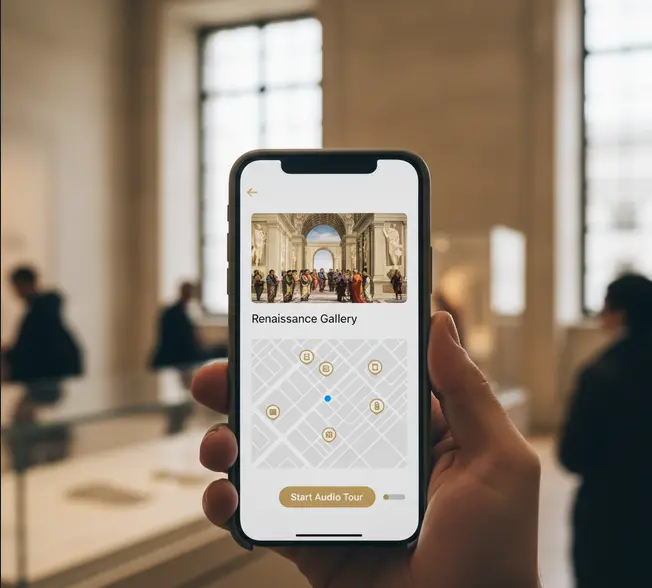
Design is at the heart of the user experience. We design clear, intuitive interfaces that also work offline. A clickable prototype shows how users navigate through the tour and experience content.
3. Technical implementation
We rely on app development Flutter for cross-platform apps (iOS & Android) and Micronaut or Spring Boot as a scalable backend. Map and GPS services are integrated via APIs such as Mapbox or OpenStreetMap. Content can be maintained using a simple editorial system, ideal for cities or museums with changing exhibitions.
4. Testing & Rollout
Before launch, we thoroughly test the app on different devices, in multiple languages, and in offline scenarios. We then handle publication in the app stores and take care of hosting, monitoring, and updates.
Tour guide app development costs
The development costs depend heavily on the scope of functions and the desired quality. A simple tour guide app with standard functions starts at approx. 25.000 €. Complex solutions with CMS, multilingualism and audio content lie between €40,000 and €80,000. The decisive factor is whether content should be maintained yourself or managed by an editorial team.
With our App cost calculator you can make an initial cost estimate and find out which functions are within your budget.
Technologies and architecture
A professional tour guide app is based on a flexible, future-proof architecture:
- Frontend: Flutter (iOS & Android)
- Backend: Micronaut or Spring Boot (Java/Kotlin)
- Database: PostgreSQL or MongoDB
- Map Services: Mapbox, Google Maps or OpenStreetMap
- CMS: Headless CMS for content and media management
FAQ: Frequently asked questions about tour guide app development
How much does it cost to have a tour guide app developed?
The costs of developing a tour guide app depend on the scope of functions, design and platform. A simple MVP with audio guidance and GPS costs around 25.000 €. For complex solutions with multilingualism, CMS and offline mode you should use 40.000-80.000 € calculate. You can get a precise assessment via our App cost calculator.
How do I find a suitable tour guide app development agency in Germany?
An experienced custom software agency Tour guide app development agency in Germany should not only develop apps, but also have expertise in tourism, UX design and audio experiences. At CodeGuides we combine technical excellence with strategic thinking, from conception to operation of your app. Arrange a free initial consultationto discuss your project.
Can I have my tour guide app developed in Germany?
Yes, you can have your tour guide app developed in Germany. Tour guide app development in Germany. The benefits include German data protection standards, GDPR-compliant storage, and German-speaking project teams. CodeGuides develops tour guide apps entirely in-house in Germany, with a strong focus on quality, data protection, and long-term operation.
How long does it take to develop a tour guide app?
Development time depends on complexity. A basic app can be in 8-10 weeks require extensive systems to be completed 3-5 months. Agile sprints let us test and expand early versions.
What are the benefits of having a tour guide app developed?
If you want a Tour guide app development, you can benefit from greater digital visibility, automated visitor guidance, and interactive experiences. Reduce staffing demands, encourage visitors to stay longer, and make your destination more appealing. A custom app can strengthen your brand and create a modern user experience.
Conclusion: Digital experiences create with tour guide apps
A tour guide app is much more than a digital city map: it's a tool for creating memorable experiences. It combines information, interactivity, and technology to deliver a modern visitor experience. For cities, museums, and tourism providers, it can help build lasting visitor relationships and reach new audiences online.
If you are planning your own tour guide app, Arrange a non-binding initial consultation now or book an experienced development team. We accompany you from the idea to go-live: quickly, professionally and with technological foresight.

CodeGuides is your partner for professional software development.
Discuss your idea in a free, no-obligation 45-minute conversation with our team.
CodeGuides: proven with mid-sized companies and enterprises









Discuss your project with us
Choose a time that works for you, and we’ll send an invitation. We look forward to speaking with you.
Choose channel
All consultations take place on Google Meet.
Date & time
Your confirmation and calendar invitation will arrive by email right away.
The appointment can be rescheduled if needed.
Summary
I look forward to our consultation

Project questions and practical answers
Should you use a city tour app builder or commission a tour guide app?
A standard tour builder may cover maps, stops and audio content. Custom development becomes relevant for offline routes, ticketing, accessibility or integrations with your existing systems. Agree who produces and licenses the media, how routes are updated and what works without a network connection. Location permissions and battery consumption need real-device tests.